Polymorphic Relationships (morphs)
A single table (e.g. Payments) that can belong to more than one kind of parent (e.g. a Supplier payment or a Customer payment), instead of one near-duplicate table per parent type.
Reference fixture:morphs-suite — Payments belongs to either Suppliers or Customers.
For the full morphs config shape, see the Module Config reference.
Fully schema-derived — no config editing at all
A column literally named {prefix}_type (string) paired with {prefix}_id (integer), same prefix, is enough:
$table->string('payable_type');
$table->unsignedBigInteger('payable_id');
// equivalently: $table->morphs('payable');php artisan make:module Custom/Suppliers
php artisan make:module Custom/Customers
php artisan make:module Custom/PaymentsGeneration order doesn't matter here — unlike a normal FK, morphTo() resolves its target at runtime (from whatever class name is stored in payable_type), not at generation time, so there's no "referenced module must already exist" requirement like a normal FK has.
What you get
PaymentsModel gets a real payable(): MorphTo { return $this->morphTo(); } method. If the migration is ever regenerated, it collapses back to a single $table->morphs('payable'); call (with no duplicate index — a real bug found and fixed while building this fixture, see Gotchas).
What you get from the generated API (as of v2.44.0)
Before v2.44.0, payable_type/payable_id were excluded from PaymentsCreateService's validation rules and from the generated CreateForm.vue entirely — the columns were correctly stripped from list/filter/view UI (no generic renderer exists for "the related record could be any of several types") but the same exclusion also silently applied to create/edit, so a POST /payments through the generated API dropped both fields before they ever reached PaymentsModel::create() (Laravel's validate() only returns declared rule keys — this project's mass-assignment convention). Creating a Payment via the HTTP API was flatly impossible; only a direct PaymentsModel::create([...]) call like the one above worked.
Fixed in v2.44.0: CreateService/EditService now validate both columns (payable_type → required|string, payable_id → required|integer, deliberately no exists: rule since a polymorphic id can reference more than one table). The rest of this page covers what the create/edit form actually renders for them, which depends on whether targets is populated.
Without targets populated — plain text/number inputs
payable_type/payable_id render as two plain inputs — a text input for payable_type (the caller types/sends the raw FQCN, e.g. App\Project\Modules\Custom\Suppliers\SuppliersModel, or a registered morph-map alias) and a number input for payable_id. This is the fallback for every module whose morphs[].targets[] is empty — including every module generated before v2.51.0.
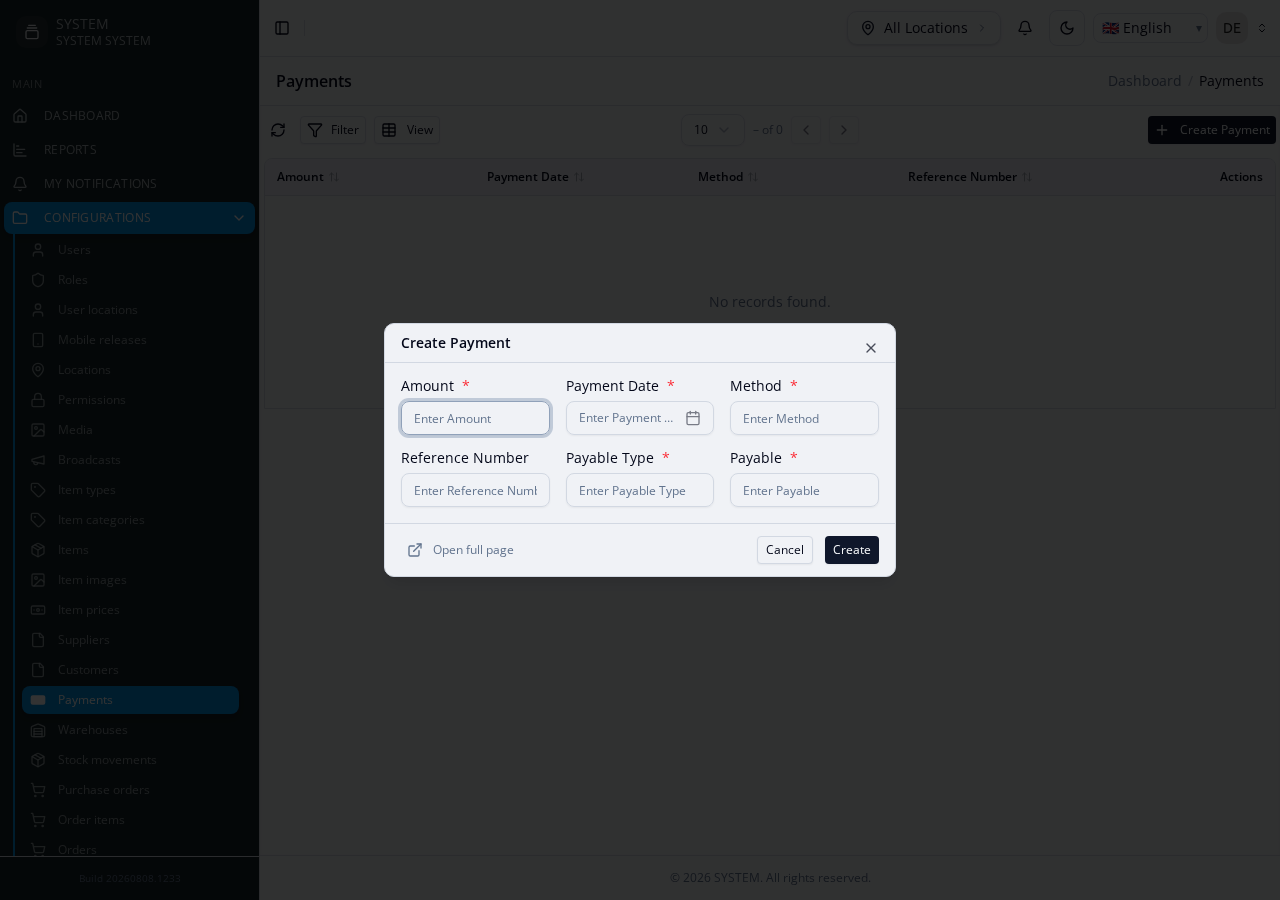
With targets populated (v2.51.0+) — a real type-selector + record picker
Populate targets and regenerate to get a dropdown (pick the type) plus an API-backed record picker scoped to whichever type is chosen, instead of the plain inputs above:
{
  "morphs": [
    {
      "name": "payable",
      "type_column": "payable_type",
      "id_column": "payable_id",
      "targets": [
        {
          "alias": "supplier",
          "model": "App\\Project\\Modules\\Custom\\Suppliers\\SuppliersModel",
          "module": "Suppliers",
          "label": "Supplier",
          "option_label": "contact_person"
        },
        {
          "alias": "customer",
          "model": "App\\Project\\Modules\\Custom\\Customers\\CustomersModel",
          "module": "Customers",
          "label": "Customer"
        }
      ]
    }
  ]
}
targets is never auto-guessed — hand-edit this into Payments/module.json after the first generation, then make:module Custom/Payments --force. Required keys: alias, model, module, label. Optional: option_label — which field of the target record to show in the record picker's option list (defaults to name; contact_person for Suppliers above). Only affects the create/edit picker — see the next section for list/view.
This also generates a Relation::morphMap() registration — on Payments itself (the model that owns payable_type/payable_id), not on Suppliers/ Customers:
protected static function boot(): void
{
    parent::boot();
    Relation::morphMap([
        'supplier' => \App\Project\Modules\Custom\Suppliers\SuppliersModel::class,
        'customer' => \App\Project\Modules\Custom\Customers\CustomersModel::class,
    ]);
}
Alias uniqueness is enforced. Relation::morphMap() is a single Laravel-global registry, not scoped per table — the same alias key can't point at two different models. Registering a conflicting alias is a hard-fail at generation time: make:modules-from-db checks every morphs[].targets[].alias across the whole blueprint before generating anything; make:module checks this run's aliases against every already-generated sibling module's module.json on disk — narrower, since it can only see modules that already exist (a documented limitation, not a bug: two not-yet-generated modules that would conflict each still pass individually until both exist and one is regenerated).
Reverse relation + delegation tab on the target side (since v3.3.0, config-driven since v3.4.0)
The inverse relationship is now available, opt-in per target. By default, only the owning side (Payments) gets a relationship method (morphTo(), or nothing beyond the plain columns if targets is empty) — Suppliers/ Customers still do NOT automatically get a payments(): MorphMany just from declaring targets. To get one, declare it directly in the TARGET module's own module.json, under the existing relations escape hatch (the same one hasMany/belongsToMany already use for cases ModelGenerator's auto-derivation can't cover):
{
  "relations": {
    "morphMany": [
      { "module": "Payments", "method": "payments", "morphName": "payable" }
    ]
  }
}
This generates a real payments(): MorphMany method on VendorsModel.php as part of Vendors' own normal ModelGenerator pass — no separate injection step, no cross-module reach-in, no ordering requirement beyond Payments being resolvable in the module registry (exactly like any other relations.hasMany/belongsToMany declaration already requires). Because it lives in persisted config rather than being spliced into a generated file after the fact, it survives every future --force regenerate for free — mergePersistedFields()-style callers already carry relations forward the same way they carry constants/delegations/actions forward.
v3.3.0's original approach spliced this method into an already-generated Model file via a dedicated
ModelRelationInjectorclass, run as a second pass after both modules existed on disk. It worked, but a later plain--forceregenerate of the target module silently wiped the spliced method — confirmed live, and the reason this moved to config in v3.4.0.ModelRelationInjectorhas been removed;relations.morphManyreplaces it entirely.
A filtered delegation tab on the target's own view page is a second, independent piece — a delegation declared on the TARGET module (e.g. Vendors) pointing at the OWNING module (Payments), with a new morphFilter key instead of relying on filterKey alone:
{
  "delegations": {
    "Vendors": [
      {
        "name": "Payments",
        "relatedModule": "Payments",
        "filterKey": "payable_id",
        "morphFilter": { "column": "payable_type", "value": "vendor" },
        "operations": { "list": { "enabled": true }, "view": { "enabled": true } }
      }
    ]
  }
}
filterKey alone would incorrectly match a PurchaseOrder or Expense whose id happens to numerically collide with this vendor's, since payable_id is shared across every polymorphic owner type — morphFilter adds the second, constant ->where('payable_type', 'vendor') clause every one of DelegationServiceGenerator's query-building methods needs. The frontend tab itself needs no special handling — this is a plain delegations entry in every other respect, so DelegationTabComponentGenerator renders it exactly like any other tab. Scope it to list+view only in almost every real case: Payments rows get created through their own dedicated flows (a wizard action elsewhere), not from inside a vendor's own view page.
Neither piece is automatic just from populating targets[].delegate in module.json/the blueprint — that key exists as documentation/config bookkeeping for a consuming app's own orchestrator to read and act on (see morphs[].targets[].delegate in schema/module-config.schema.json and schema/scaffold-blueprint.schema.json); this package only provides the two building blocks above, the same way it provides ModelGenerator/ DelegationServiceGenerator themselves without deciding when to call them.
List/view rendering. payable_type/payable_id are stripped from list/filter/view UI entirely, with or without targets populated — no generic renderer exists for "the related record could be any of several types," and option_label only ever affects the create/edit record picker, not how an existing record's polymorphic relation displays elsewhere.
See the fixture's own README for the full verification steps, including a real end-to-end Playwright pass (type dropdown → record picker → submit → list) and the alias-conflict hard-fail confirmed firing live.
Writing a morph type from your own code
Never write {Module}Model::MODULE into a *_type column
Relation::morphMap() is registered with the snake_case alias from morphs[].targets[] ('supplier'), while MODULE is the PascalCase module name ('Suppliers'). Writing MODULE stores a type string that resolves to no model at all.
Nothing throws. The insert succeeds, the column looks plausible, and the row simply never resolves — $settlement->payable is null forever, and a morph-filtered delegation silently lists nothing. Reported by a consuming project on 2026-08-25, caught by inspection before it reached data.
// ✗ wrong — stores 'Suppliers', which morphMap() never registered
$payment->allocatable_type = SuppliersModel::MODULE;

// ✓ right — asks the model what its registered morph alias is
$payment->allocatable_type = (new SuppliersModel)->getMorphClass();
getMorphClass() returns the alias when the model is in the morph map and the FQCN when it is not, so it is correct either way and stays correct if the alias changes. Assert it in a test — the alias is a string in config, and nothing else in the stack will notice if it drifts:
$this->assertSame('supplier', (new SuppliersModel)->getMorphClass());