Custom Actions & Bulk Actions
A state-transition button (Approve, Reject, Mark Received) that isn't part of ordinary create/edit/delete — either a single-record action, or a list-level bulk action applied to many selected records at once. These are two separate, unrelated mechanisms that happen to share the word "action" — don't confuse them.
Reference fixture:actions-suite — PurchaseOrders.
For the full config shapes, see the Actions reference (single custom actions) and Features Config reference (bulk_actions/export/import, nested under features.backend.list).
Single custom action — actions config key, hand-authored
"actions": {
  "approve": {
    "name": "approve",
    "label": "Approve",
    "hasUI": true,
    "uiType": "modal",
    "urlParams": ["uuid"],
    "operations": {
      "view": {"enabled": true, "endpoint": {"method": "POST", "path": "/purchase-orders/{uuid}/approve"}}
    }
  }
}view, not create, is the operation to enable here — this mirrors the Actions reference's own convention (every example there ships view: {enabled: true} with create: {enabled: false}) and every real action in production: SYSTEM_SHELL's Users.resendInvitation and every custom action Pangisha has built all enable view. An action like approve transitions an existing record, and create collides in meaning with the module's own literal Create operation — view is the honest fit. This actions-suite fixture itself still ships with create from before that convention was settled; it happens to still generate a working route/form either way (buildEndpointExpression() matches whichever single operation is enabled), but don't copy it — follow view, as above.
Regenerate with --force, then hand-fill the actual logic in Services/PurchaseOrdersApproveService.php's process() method — starts as a literal // Add your custom logic here stub, and since v3.1.7 the file is written via writeFileOnce(), so your hand-fill survives every later --force regenerate of this module untouched:
protected static function process(array $data, string $uuid, array $params = []): array
{
    $model = PurchaseOrdersModel::where('uuid', $uuid)->firstOrFail();
    $model->update(['status' => 'approved']);
    return Helpers::success($model->fresh(), 'Purchase order approved');
}
Add fields[] (and, for a multi-step flow, wizard/confirm_step) to the actions.approve config to have the generated Form.vue arrive pre-populated with real inputs instead of a blank stub — see the Actions reference for the full field shape. Form.vue is also writeFileOnce()-protected.
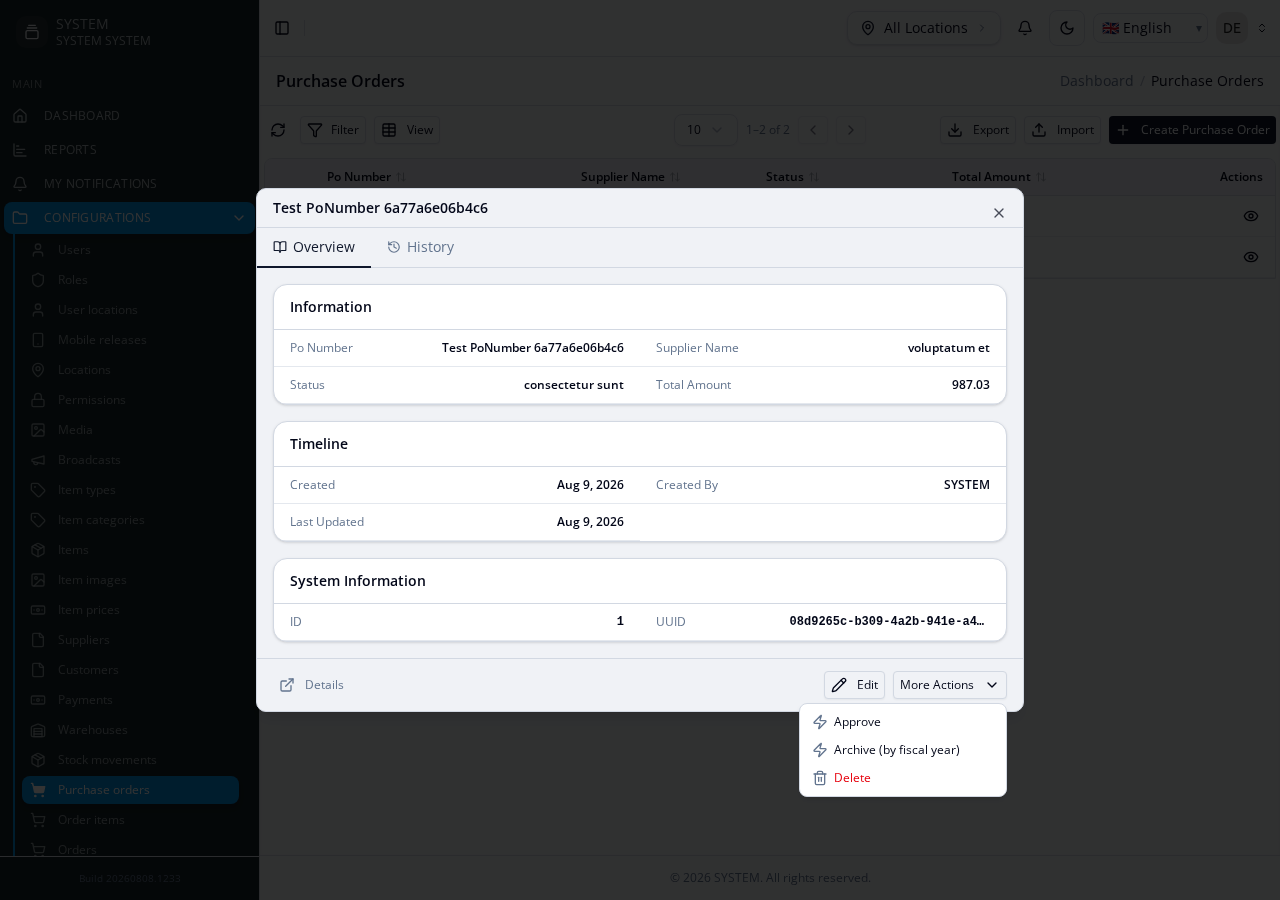
You also get a real route (POST /purchase-orders/{uuid}/approve, permission PurchaseOrders.approve) and — since hasUI: true — a generated form, plus a button wired into the view page — both custom actions this fixture defines (approve, archiveByYear) show up under "More Actions" on the record's view modal:
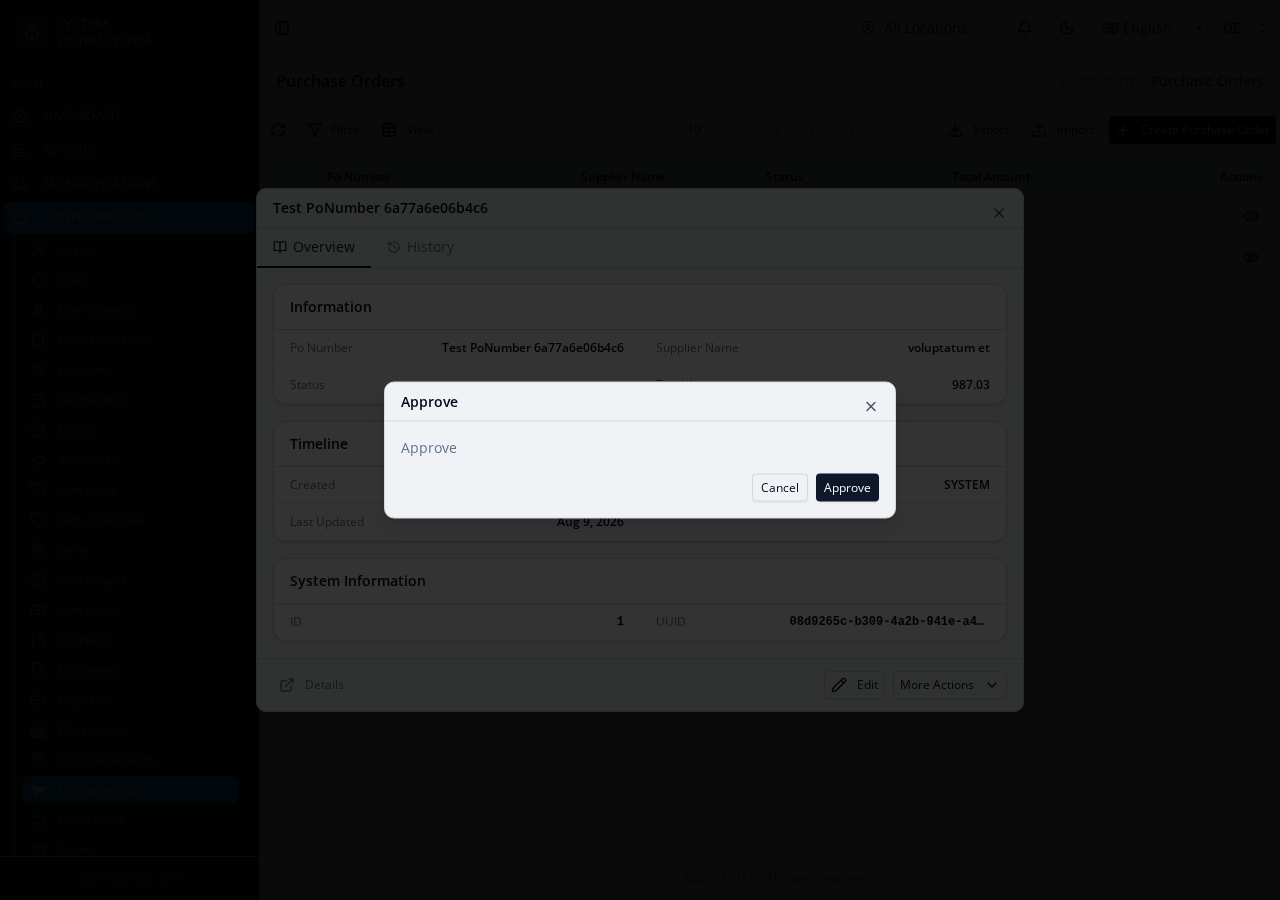
Clicking "Approve" opens the generated modal — real fields, wired to the real route above:
You also get a generated PHPUnit contract test (route registered + requires its permission, and the placeholder body never hard-fails) — but only when urlParams is [] (the default route shape) or exactly ['uuid'], as in this example. Any other shape — multiple params, or a param name other than uuid — silently produces zero test methods for that action, with no warning at generation time (PhpUnitTestGenerator::buildActionServiceTestMethodsForKey(), since v2.44.0; before that fix, ['uuid'] itself was also uncovered — see Gotchas). If backend test coverage matters for a multi-param action, write the contract test by hand.
Bulk action — a different, nested config location
features.backend.list.bulk_actions, not part of actions at all, no shared shape:
{"features": {"backend": {"list": {"bulk_actions": [
  {"key": "archive", "label": "Archive"}
]}}}}
This emits Services/PurchaseOrdersArchiveService.php with a staticexecute(array $data, array $params): array — the same static calling convention the single-action mechanism uses too (ProductsApproveService::execute() above is also static); the two mechanisms differ only in signature ($data, $params here vs. $data, ...$urlParams, $params = [] for a single action with urlParams), not in static-vs-instance. Without a status_target, it's the same kind of empty TODO stub as a single action.
Since v2.29.0 this also renders a real bulk-action toolbar in the generated PurchaseOrdersListPage.vue — it appears once one or more rows are selected, dispatches to the always-present POST /purchase-orders/bulk-action route, and is gated by PurchaseOrders.bulkAction:
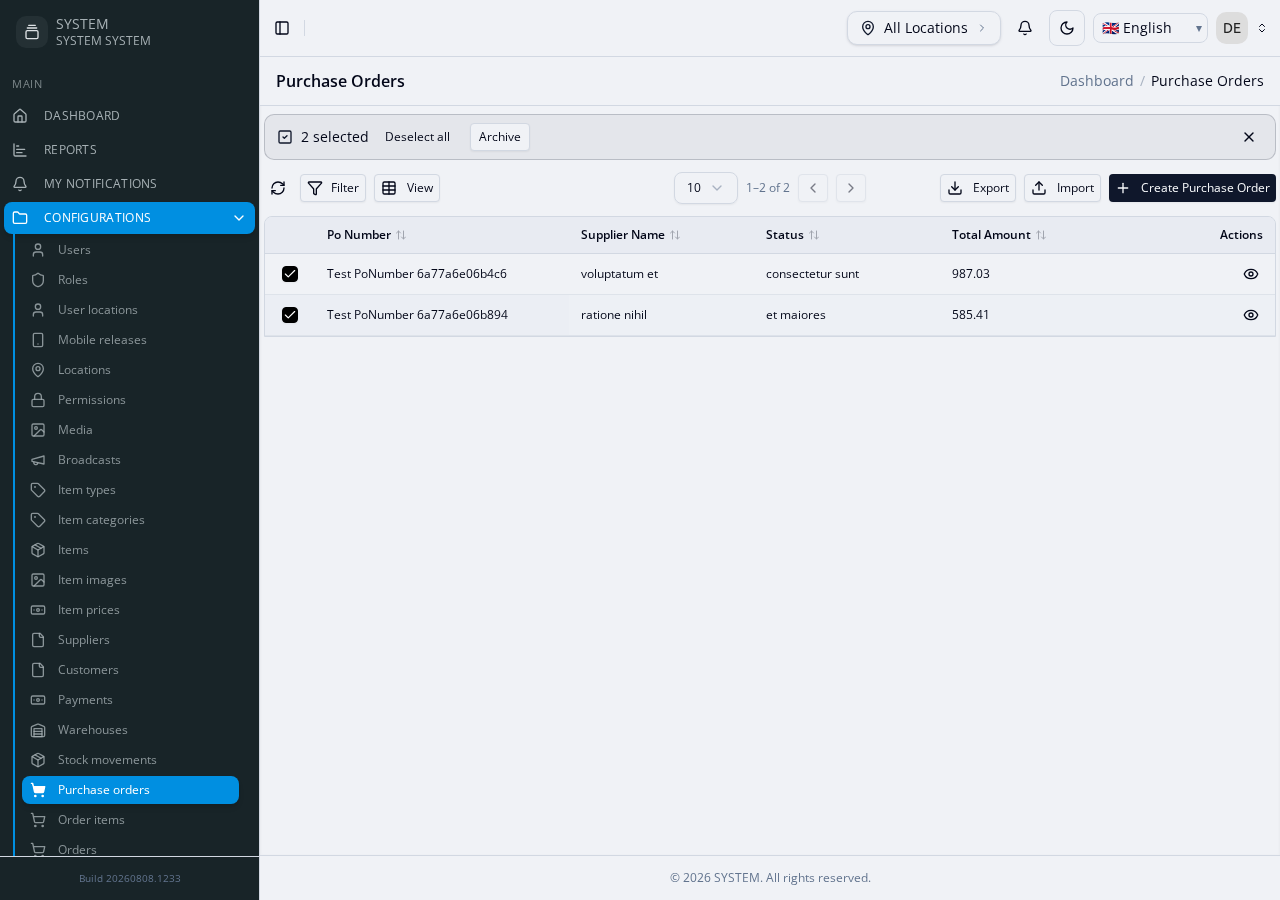
The sibling features.backend.list.export/.import keys get the same treatment (a real export button, a real import dialog) — see Features Config › Frontend wiring for bulk actions, export, and import for the full picture, including the actions-suite fixture's own export: true/import: true config.
Gotcha — status_target always writes to a status_id column, whatever your real column is named
// what status_target => 'RECEIVED' actually generates:
$model->update(['status_id' => PurchaseOrdersModel::RECEIVED]);
BulkActionServiceGenerator::buildActionBody() hardcodes the column namestatus_id — it is not derived from your schema. The referenced constant comes from a completely separate top-level constants config key:
{"constants": {"RECEIVED": 3}}constants itself is not numeric-only — it's a flat {NAME: value} map emitted verbatim as public const NAME = value; (numeric values unquoted, everything else quoted as a PHP string), so {"RECEIVED": "RECEIVED"} works identically well as a constant. The break is the column, not the constant's type: status_target against this fixture's plain string status column (deliberately used here to stay self-contained) generates a reference to a status_id column that doesn't exist, regardless of what value the constant holds. If your module's status column isn't literally named status_id, skip status_target and hand-fill the transition yourself, same as a single custom action.
Gotcha — bulk_actions/export/import need the same --force-survival care as inline_items
They live at nested config paths (features.backend.list.bulk_actions, .export, .import), which the consuming project's ModuleScaffolder::mergePersistedFields() did not originally cover. Confirmed live while building this fixture: a --force regenerate silently dropped a hand-added bulk_actions entry entirely while the sibling top-level actions key correctly survived the same regenerate. Fixed in the same pass — see Gotchas. export/import were added to this fixture later (v2.29.0) and got the preserved-fields fix proactively, before either could reproduce the same bug a third time.
See the fixture's own README for the full verification steps.